What if the most intimidating road in the Julian Alps was actually your most rewarding day on two wheels? You’ve likely stared at photos of the 50 legendary hairpins and wondered if your legs, or the unpredictable mountain weather, might hold you back. It’s natural to feel dwarfed by a 1,611-meter summit and gradients that hit 15% on those historic cobblestones. However, a Vršič Pass cycling tour isn’t just for elite athletes anymore. With the right preparation and local expertise, this bucket-list climb becomes an achievable adventure that rewards every pedal stroke with some of the most dramatic panoramic views in Europe.
We understand that you want to reach the top safely while soaking in landmarks like the historic Russian Chapel without worrying about logistics or gear failure. This guide promises to show you exactly how to conquer the pass in 2026, utilizing modern e-bike technology and expert support to bypass the typical stresses of high-altitude riding. We’ll preview the new traffic regulations, the best timing to avoid the summer shuttle crowds, and the high-quality equipment that ensures your journey through Triglav National Park is both seamless and exhilarating.
Key Takeaways
- Conquer Slovenia’s highest road by mastering 50 legendary hairpins and an 800-meter elevation gain with professional pacing.
- Discover why a guided Vršič Pass cycling tour is the safest way to navigate 2026 traffic regulations while enjoying support from local experts.
- Explore historic landmarks like the Russian Chapel and the Heathen Maiden rock formation as you climb toward the 1,611-meter summit.
- Leverage high-quality equipment and e-bike options to make the steep 12% gradients manageable for a wide range of physical fitness levels.
- Streamline your logistics with private transfers and expert route planning, ensuring seamless connections between all stages of your Vršič Pass adventure.
Why the Vršič Pass is Slovenia’s Most Iconic Cycling Ascent
Vršič Pass isn’t just a road; it’s a rite of passage for anyone who loves the mountains. Reaching a staggering 1,611 meters, it proudly claims the title of the highest mountain pass in Slovenia. This winding asphalt ribbon serves as a vital artery, connecting the rugged northern alpine landscapes near Kranjska Gora with the ethereal, emerald waters of the Soča Valley. For those embarking on a Vršič Pass cycling tour, the journey offers more than just physical exertion. It provides a direct line through the heart of the Julian Alps, where history and nature collide. The Vršič Pass stands as the definitive pinnacle of Slovenian alpine cycling history, weaving together a legacy of engineering marvels and breathtaking natural beauty.
The Legend of the 50 Hairpins
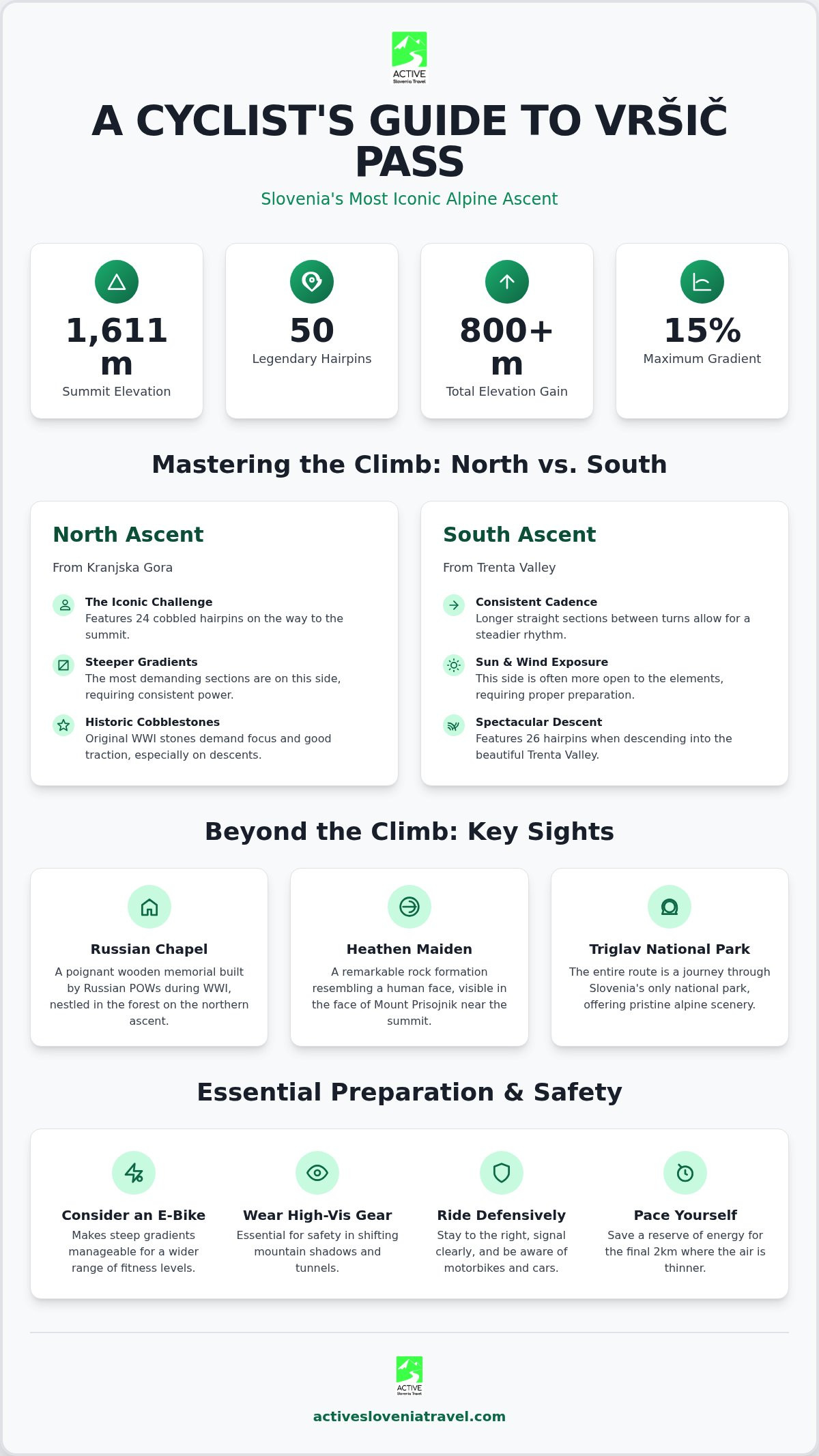
Every cyclist who tackles this route knows the significance of the blue signs marking each turn. The climb is defined by 50 numbered hairpin bends that dictate the rhythm of your ascent and keep your mind occupied. If you start from the north, you’ll face 24 turns on the way up, leaving 26 to navigate as you drop toward the Trenta Valley. Many of these turns still feature the original cobblestones from the road’s construction during World War I. These stones add a layer of tactical complexity, especially for road bikes with high-pressure tires. While the climb tests your lungs, the descent demands absolute focus. Those same cobblestones and sharp angles require precise braking and a steady hand to navigate safely, making the journey down just as engaging as the battle up.
A Journey Through Triglav National Park
Beyond the technical challenge, the pass acts as a gateway to the pristine wilderness of Triglav National Park. As you pedal higher, the scenery undergoes a dramatic transformation that rewards your persistence. You’ll begin under the canopy of dense, fragrant pine forests, but the air soon thins and the trees give way to high-alpine scree slopes. The limestone giants of Prisojnik and Mojstrovka loom overhead, their jagged faces providing a stark, magnificent backdrop to your effort. This isn’t just a workout; it’s an immersive experience in Slovenia’s only National Park. The shifting flora and the sheer scale of the mountains remind you why a Vršič Pass cycling tour is considered a bucket-list experience for riders from around the globe.
Mastering the Climb: Elevation, Gradient, and Route Details
Mastering the Vršič Pass cycling tour requires a blend of physical grit and mental rhythm. The core climb spans between 9 and 12 kilometers of continuous ascending, depending on where you click your pedals into place. You’ll face a total elevation gain of approximately 800 to 900 meters. While the average gradient hovers around a steady 8%, don’t let that number deceive you. The maximum pitches frequently reach 12% specifically within the hairpins, where the transition between asphalt and cobblestones demands extra torque. A professional cyclist might reach the summit in under 45 minutes, but most recreational riders find that 90 minutes to two hours allows for a sustainable pace and better appreciation of the surroundings.
Climbing Strategy for the North vs. South Side
Approaching from the north side, starting in Kranjska Gora, puts you face-to-face with the most iconic section of the Vršič Pass cycling tour. Here, you’ll encounter the steepest turns and the most frequent cobblestone segments. It’s vital to stay seated during these transitions to maintain traction and avoid spinning out on the smooth stones. On the other hand, the southern approach from the Trenta Valley offers longer straights that allow for a more consistent cadence. However, this side is often more exposed to the mountain sun and alpine winds. Whichever side you choose, save a “reserve tank” for the final two kilometers. The air thins as you approach the 1,611-meter mark, and the last few turns often feel the heaviest. If you’re looking for professional support or high-end gear to handle these gradients, you can explore the options for a premium guided bike tour through the valley.
Safety and Road Etiquette in the High Alps
Riding in the high Alps involves more than just leg power; it requires sharp road awareness. During the peak summer months of July and August, you’ll share these narrow lanes with motorcycles, campers, and the occasional local bus. Always stay to the right and signal clearly before navigating the hairpins. High-visibility gear isn’t just a suggestion; it’s a necessity for being seen in the shifting mountain shadows. Because the pass is located within the protected territory of Triglav National Park, expect to see plenty of hikers and wildlife near the roadside. Finally, remember that mountain weather is fickle. Even if it’s 25°C in the valley, temperatures at the summit can drop significantly. Always carry a windproof layer for the descent to prevent your muscles from seizing up in the cold alpine air. Reliable brakes are your best friend on the way down, as those 50 turns come at you fast.
Beyond the Climb: Historic Landmarks and Scenic Highlights
While the physical grit of the climb is undeniable, the true soul of a Vršič Pass cycling tour lies in the stories etched into its limestone walls. This road isn’t just a transport route; it’s a living museum that demands you slow down and look beyond your handlebars. As you navigate the lower hairpins, the dense forest air feels heavy with history, eventually giving way to the high-alpine grandeur that defines the Julian Alps. Stopping to admire these landmarks doesn’t just enrich your journey. It provides your legs with vital recovery time before tackling the steeper gradients that wait above the tree line.
The Russian Road: A Century of History
The road you’re riding was forged under brutal conditions during World War I to supply the Isonzo front. Near turn 8, you’ll encounter the Russian Chapel, a poignant wooden memorial built by Russian prisoners of war in 1916. Its delicate Orthodox design and dark timber stand in stark contrast to the grey mountain peaks. Taking a moment here allows you to appreciate the architectural significance of the site while letting your heart rate stabilize. Many cyclists find that these short, meaningful breaks are the secret to maintaining a consistent pace throughout the entire Vršič Pass cycling tour, turning a grueling workout into a reflective adventure.
Panoramic Viewpoints You Cannot Miss
As the forest thins, the Julian Alps begin to reveal their most famous secrets. Keep a sharp eye on the northern face of Mount Prisojnik to spot the “Heathen Maiden” (Ajdovska deklica), a natural rock formation that bears an uncanny resemblance to a girl’s face. Higher up, you’ll see the Prisojnik Window, a massive natural hole in the mountain that looks like a giant eye watching over the pass. These natural wonders are best viewed from the upper hairpins, which also offer the perfect vantage point for the classic “serpentine” photo of the road winding below.
- Turn 16 to 20: Best for capturing the dramatic zig-zag pattern of the northern ascent.
- The Summit (1,611m): Visit the local mountain huts (koča) for a bowl of traditional Slovenian alpine stew like jota or ričet.
- The Southern Descent: Look for the source of the emerald Soča River as you drop toward the Trenta Valley.
- Wildlife Spotting: High crags often hide chamois or golden eagles, especially during the quieter morning hours.
Reaching the summit is a triumph, but the experience is incomplete without a stop at one of the mountain huts. These cozy outposts are the heart of Slovenian mountain culture, offering warmth and hospitality that have welcomed travelers for decades. Savoring a hearty meal at 1,611 meters, surrounded by the jagged silhouettes of Mojstrovka and Prisojnik, is the ultimate reward for your effort. It’s the perfect moment to reflect on the climb before you begin the exhilarating descent into the emerald heart of the Soča Valley.
Essential Preparation: Gear, Weather, and E-Bike Options
Selecting the right equipment is the first step toward a successful Vršič Pass cycling tour. While road bikes are the traditional choice for speed, many riders now opt for trekking or mountain bikes to gain better stability on the historic cobblestone sections. If you’re tackling the pass on a standard road bike, a compact crankset paired with a 32-tooth or 34-tooth rear cassette is the optimal gear ratio for maintaining a smooth cadence on the steepest 12% ramps. This setup allows you to keep your legs moving without grinding, which is essential for surviving all 50 turns without burning out before the summit.
Why E-Bikes are a Game Changer for Vršič
The introduction of high-performance electric motors has completely redefined alpine cycling. With our The Ultimate Explorer E-bike Tour, the focus shifts from agonizing over every pedal stroke to actually absorbing the grandeur of the Julian Alps. These bikes level the playing field, allowing couples or groups with varying fitness levels to reach the 1,611-meter summit together without anyone being left behind. Battery management is straightforward; modern e-bikes easily handle the 50 hairpins on a single charge provided you use the assistance modes intelligently. You get the thrill of the alpine climb and the fresh mountain air without the physical exhaustion that often masks the beauty of the surroundings.
The Best Time of Year for Your Cycling Tour
Timing is everything when dealing with high-altitude environments. Late May and June are spectacular, as the valleys turn a vibrant, lush green and snow often still clings to the jagged limestone peaks. If you prefer a different palette, September and October offer stable weather and the golden transformation of the larch trees. Regardless of the season, an early morning start is your best strategy. You’ll beat the midday heat and the peak traffic from the summer shuttles, ensuring a quieter and safer journey.
Weather in the mountains changes in minutes, so don’t rely solely on the valley forecast. We always recommend the “three-layer rule” to our guests. Start with a moisture-wicking base layer, add a light insulating mid-layer for the summit chill, and always carry a high-quality windproof shell for the descent. even in the height of July, the temperature difference between the valley and the pass can be over 10°C. Being prepared means you can enjoy the exhilarating 10-kilometer descent into the Trenta Valley without shivering, keeping your focus exactly where it belongs: on the road ahead.
Planning Your Vršič Adventure with Active Slovenia Travel
Planning a Vršič Pass cycling tour shouldn’t feel like a logistical puzzle. At Active Slovenia Travel, we believe the focus should remain on the crisp alpine air and the personal achievement of the climb, not the stress of transport or mechanical worries. Our guided experiences bring the Julian Alps to life through local stories that you won’t find in any guidebook. We prioritize a small-group philosophy to ensure every rider receives personalized attention, whether they need a tip on pacing or a quick adjustment to their gear. This approach turns a challenging day on the road into a seamless, high-value experience.
Guided vs. Self-Guided: Which is Right for You?
Choosing between a guided or self-guided journey depends entirely on how you like to explore. A guided tour offers ultimate peace of mind. You’ll have a professional expert leading the way and a support vehicle nearby to handle any unexpected mechanical issues or fatigue. If you’re an independent spirit, our self-guided options provide high-performance gear, detailed maps, and seamless luggage transfers. Our local experts are always on hand to suggest the best lunch spots at the summit huts, helping you avoid the busiest tourist crowds and find the most authentic flavors of the region.
We specialize in making the complex simple. Our private transfers Bovec service handles the heavy lifting, getting you and your bike to the ideal starting point without the hassle of navigating mountain parking regulations. If you’re looking for a deeper immersion, we can easily blend the Vršič ascent into a larger multi-day Slovenia cycling itinerary. This flexibility allows you to transition from the high-alpine pass to the emerald trails of the Soča Valley, creating a narrative of discovery that spans the very best landscapes the country has to offer.
Booking Your Premium Slovenia Day Tour
Reserving your spot on a Vršič Pass cycling tour is the first step toward an unforgettable 2026 adventure. Our packages typically include high-quality equipment rentals, expert guiding, and the logistical support needed to navigate the 50 hairpins with confidence. We recommend booking your road bikes or e-bikes well in advance, especially for peak dates in June or September when the mountain conditions are most favorable. Ready to conquer the hairpins? Explore our Slovenia premium day tours and book your Vršič adventure today!
Claim Your Place on the Summit in 2026
Conquering the highest road in the Julian Alps is a defining moment for any cyclist. By now, you’ve seen that a Vršič Pass cycling tour is much more than a test of physical strength. It’s a journey through history, from the poignant Russian Chapel to the jagged limestone peaks that watch over every hairpin. You have the strategy for the 12% gradients and the knowledge to prepare for the fickle mountain weather. With the e-bike revolution, the barrier to the 1,611-meter summit has finally vanished, opening these legendary views to every adventurous spirit.
Let us take the weight of logistics off your shoulders. We specialize in small-group tours led by local expert guides who know every turn of the road. From high-performance e-bike and MTB rentals to seamless private transfers across Slovenia, we ensure your focus stays on the spectacular surroundings. Book your Vršič Pass cycling adventure with Active Slovenia Travel today. The emerald Soča Valley is calling, and the view from the top has never looked better. We can’t wait to see you at the summit.
Frequently Asked Questions
Is the Vršič Pass cycling tour suitable for beginners?
A traditional Vršič Pass cycling tour is best suited for intermediate riders due to the 800-meter elevation gain. However, beginners can successfully conquer the summit using a high-performance e-bike. The electric assistance smooths out the 12% gradients in the hairpins, allowing those with less alpine experience to enjoy the journey without extreme physical strain. It’s an excellent way to experience the Julian Alps without needing professional-level fitness.
How long does it take to cycle the Vršič Pass?
Most recreational cyclists take between 90 minutes and three hours to reach the 1,611-meter summit. This time frame includes short stops at the Russian Chapel or scenic viewpoints to recover and take photos. Professional riders often complete the ascent in under 45 minutes. If you’re on a relaxed e-bike tour, you’ll find two hours to be the perfect pace for a comfortable climb that leaves you with energy for the descent.
Are the cobblestones on the Vršič Pass dangerous for road bikes?
The cobblestones are not inherently dangerous, but they do require extra focus and proper bike handling skills. On a road bike, the transition from smooth asphalt to the historic stones can feel jarring, especially in wet conditions. It’s best to stay seated and maintain a steady cadence to keep traction. Using slightly wider tires with lower pressure can significantly improve your comfort and grip on these sections, making the descent much safer.
Can I rent an e-bike for the Vršič Pass climb?
You can certainly rent a high-performance e-bike specifically designed for alpine climbing. These bikes are a popular choice for a Vršič Pass cycling tour because they allow you to focus on the panoramic views of the Julian Alps rather than the physical struggle. We provide modern e-MTB and trekking e-bikes that feature long-lasting batteries. This ensures you have plenty of power for all 50 hairpins and the exhilarating return descent into the valley.
What happens if the weather turns bad during the tour?
Mountain weather in Slovenia can shift rapidly, so safety is always our top priority. If conditions become hazardous, we may adjust the start time or suggest an alternative route in the Soča Valley. For guided groups, your expert guide monitors real-time radar data to ensure you aren’t caught in a storm at high altitude. We always advise carrying a windproof and waterproof layer regardless of the initial forecast to stay warm.
Is there a support vehicle available for guided tours?
Our premium guided tours include a dedicated support vehicle that follows the group or meets you at strategic points. This vehicle carries extra water, snacks, and mechanical tools to handle any technical issues on the road. It also provides a safe option for riders who might feel fatigued and want to skip a few hairpins. This ensures everyone reaches the summit comfortably and on schedule, regardless of their individual energy levels throughout the day.
What is the best month to cycle the Julian Alps?
The most reliable months for cycling in the Julian Alps are June and September. June offers long daylight hours and vibrant green landscapes, while September provides stable temperatures and the stunning golden hues of the larch trees. July and August are also excellent for weather, but you should start early in the morning. This helps you avoid the peak summer traffic and the midday heat often found in the lower alpine valleys.
Do I need a special permit to cycle in Triglav National Park?
You don’t need a special permit to cycle over the Vršič Pass or through Triglav National Park. The road is open to all cyclists, though you must follow standard traffic regulations and park rules. This includes staying on designated roads and respecting the natural environment. While entry to the park is free, remember that parking at the summit is restricted under the 2026 traffic regulations to protect the sensitive alpine ecosystem from congestion.